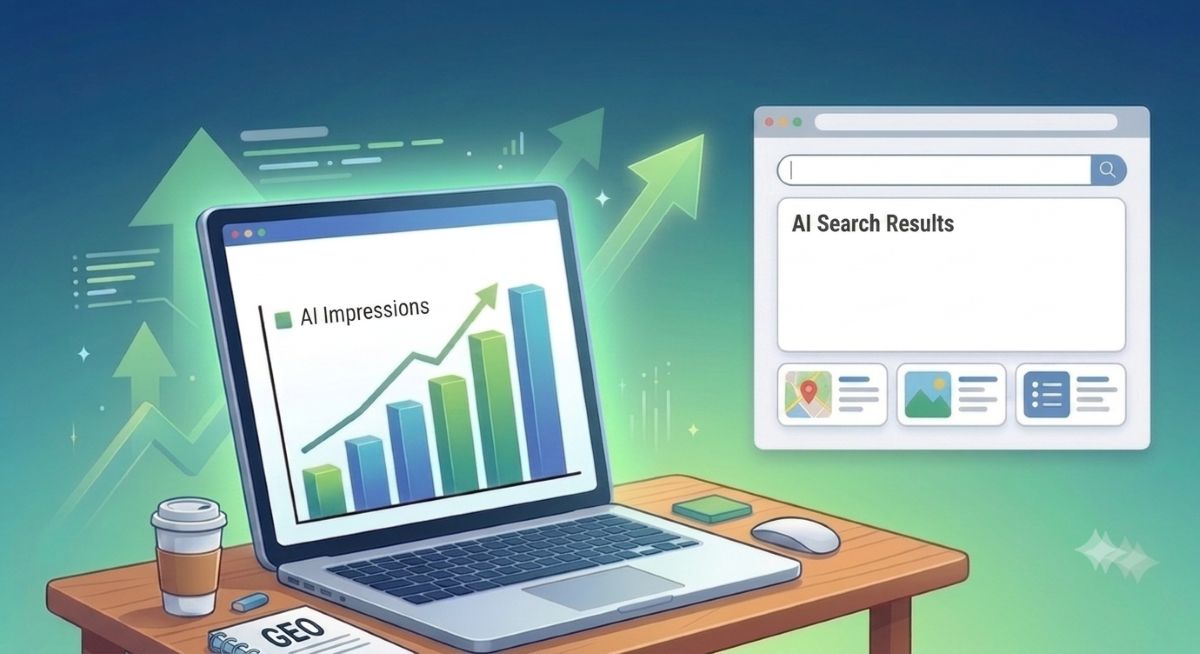
Google Search Console can now show how often a website appears in Google’s generative search experiences.
The new Generative AI performance report measures impressions from AI Overviews and AI Mode. It also identifies the pages receiving those impressions and lets site owners segment the data by country, device and date.
That gives businesses a clearer way to measure Google Search Console AI visibility without relying entirely on manual prompt testing.
There is one important limitation: Google is initially rolling out the report to a subset of website owners. A property may not have access yet, even when its pages already appear in AI-generated results.
What Does Google Search Console’s AI Report Show?
Google defines an impression as an instance in which a link to a website appears within a generative AI feature.
The report currently includes:
- Total generative AI impressions
- Pages shown in AI results
- Visibility by country
- Visibility by device
- Performance by date
Google’s official announcement says the data covers AI Overviews and AI Mode. The company may add more metrics over time, but the first version focuses on impressions rather than providing a complete AI-specific breakdown of clicks, queries, rankings or conversions.
That distinction matters. An AI impression confirms exposure. It does not prove that someone visited the site, contacted the business or became a customer.
Why AI Visibility Matters to Small Businesses
Traditional SEO reporting usually centres on keyword rankings, clicks, sessions and conversions. Those metrics remain essential, but they no longer describe every interaction occurring within Google.
AI Overviews can summarize information directly on the results page while displaying links to supporting sources. A business may therefore earn meaningful brand exposure even when the user does not immediately visit its website.
This creates a new measurement layer for companies investing in AI search visibility for small businesses.
A Manhattan event venue, for example, could appear as a source when Google answers questions about corporate event capacity, venue accessibility or production facilities. The venue gains exposure during the research stage, even when the final inquiry happens days later.
That is particularly relevant in competitive markets. Businesses served by a Manhattan digital marketing agency often need to measure visibility across longer, more complex buying journeys—not only last-click traffic.
Seven AI Visibility Metrics Businesses Should Track
1. Total generative AI impressions
Start with the number of times Google displayed a URL from the website in AI Overviews or AI Mode.
Record the first available month as a baseline. A single total has limited value, but repeated reporting reveals whether visibility is expanding.
2. Month-over-month impression growth
Compare generative AI impressions monthly and quarterly.
Short-term fluctuations are normal. A sustained increase is more useful than a one-week spike, particularly when Google is still developing its generative search products.
3. Top AI-visible pages
Identify the URLs generating the highest number of impressions.
Then classify them by type:
- Service pages
- Location pages
- Educational articles
- Case studies
- Comparison pages
- Frequently asked questions
This analysis can reveal which formats Google considers relevant enough to surface in generated answers.
4. Visibility by country
Review where AI impressions originate.
A local company serving New York and New Jersey gains little commercial value from a large increase in impressions from countries outside its service area. Relevant geographic visibility is more important than raw reach.
Location data can also expose opportunities to create more useful city, borough or regional content.
5. Visibility by device
Compare desktop, mobile and tablet impressions.
Mobile visibility deserves particular attention for restaurants, venues, healthcare practices, home-service companies and other local businesses. Their customers often move quickly from discovery to calls, directions or booking actions.
6. Organic traffic to AI-visible pages
Connect Search Console data with GA4.
A page may gain AI impressions without receiving a proportional increase in organic sessions. That does not automatically mean the visibility has no value, but it does show why impressions and website visits must be reported separately.
Compare AI-visible pages against:
- Organic landing-page sessions
- Engaged sessions
- New users
- Returning users
- Assisted conversions
This produces a more useful picture than impressions alone.
7. Leads and revenue from visible pages
The final measurement is business impact.
Track contact forms, phone calls, bookings, purchases and other meaningful actions generated by pages appearing in AI search.
A page with 2,000 impressions and no qualified actions may require a clearer offer or stronger next step. A page with 200 impressions and several high-value inquiries may be far more commercially important.
Blast Marketing’s NYC event venue marketing case study illustrates why reporting must connect visibility and campaign activity to conversions and acquisition costs; not just traffic.
How to Interpret AI Visibility Data
Three common patterns can guide the next action.
- AI impressions and organic traffic are rising: The website is receiving more exposure and attracting more visits. Review conversions before increasing investment.
- AI impressions are rising, but traffic is flat: Google is surfacing the content, but users may be receiving enough information within the generated answer. Strengthen the page’s unique value with original data, examples, tools or deeper analysis.
- AI impressions are falling: Review content freshness, source quality, technical accessibility and topical coverage. Avoid assuming one cause from a single reporting period.
Your goal is not to maximize every impression. It is to increase qualified AI search impressions that generate leads.
How Businesses Can Improve AI Search Visibility
Google has not published a separate shortcut for ranking in AI Overviews. Its guidance continues to emphasize useful, accessible and original content.
Businesses should:
- Answer specific customer questions early on the page.
- Publish first-hand examples, case studies and original data.
- Use descriptive headings that clearly identify each topic.
- Add author information and relevant professional experience.
- Keep prices, services, dates and factual claims current.
- Build internal links between related service, location and educational pages.
- Make pages crawlable and indexable.
- Use accurate structured data where appropriate.
A useful next step is to map each core service to its supporting questions.
AI Visibility Is a New Reporting Layer.. Not a Replacement for SEO
Google Search Console’s generative AI report gives businesses a stronger starting point for understanding exposure in AI Overviews and AI Mode.
It does not replace rankings, traffic, engagement, leads or revenue. It adds context.
Establish a baseline, identify which pages receive AI impressions and compare those pages with actual customer actions. That is how businesses can separate interesting visibility from visibility that contributes to growth.
Frequently Asked Questions
Does Google Search Console track AI Overview visibility?
Yes. Google’s Generative AI performance report includes impressions from AI Overviews and AI Mode. The report is being introduced gradually, so it may not yet appear in every Search Console property.
Can Search Console show which AI queries displayed my website?
The initial report does not provide a dedicated query dimension. It currently groups generative AI impression data by page, country, device and date.
Why can’t I see the Generative AI report?
Google says access is limited during the rollout. The report may also remain unavailable when a property has not received enough generative AI impressions or has excluded its content from eligible AI features.
Is an AI impression the same as a website visit?
No. An impression means that Google displayed a link to the site inside a generative AI feature. A visit is recorded only when someone follows a link and reaches the website.
Is GEO replacing traditional SEO?
No. Generative engine optimization expands the focus to include visibility within AI-generated answers. Technical SEO, content quality, topical authority, local relevance, links and conversion measurement remain necessary.