
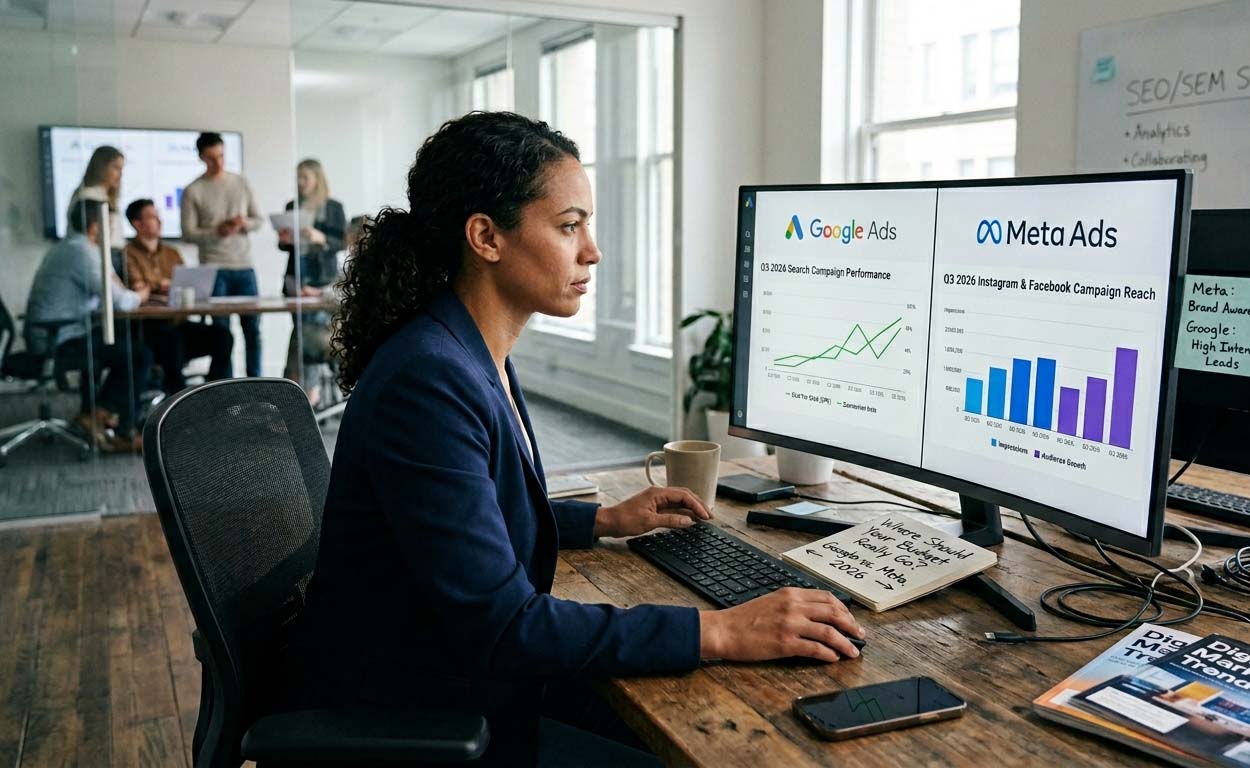
Paid advertising in 2026 is about matching budget to buyer intent. Google Ads usually reaches people who are already searching for an answer. Meta Ads reaches people while they browse, watch, compare, save, and react.
The quick answer: use Google when demand already exists. Use Meta when demand needs to be created, warmed up, or retargeted. Many businesses need both, but not in equal amounts.
Key Takeaway
For most brands, Google Ads vs Meta Ads 2026 comes down to intent.
- Choose Google Ads when customers search for a product, service, quote, demo, or urgent solution.
- Choose Meta Ads when your offer depends on visual appeal, education, social proof, or repeat exposure.
- Use both when you need lead capture, remarketing, and testing.
Google’s Performance Max can serve ads across Search, YouTube, Display, Discover, Gmail, and Maps from one campaign. Google also said legacy Dynamic Search Ads features will begin moving into AI Max for Search in September 2026. Meta gives advertisers broad social placements across Facebook, Instagram, Messenger, WhatsApp, and Threads.
Google Ads vs. Meta Ads: Side-by-Side Comparison
| Factor | Google Ads | Meta Ads |
| Best use case | Capturing active demand | Creating and warming demand |
| Buyer mindset | Searching with intent | Browsing or discovering |
| Common strengths | Local leads, ecommerce search, B2B inquiries | Visual ads, retargeting, lifestyle products |
| Main risk | Expensive clicks | Traffic that does not convert |
When Google Ads Deserves More Budget
Google Ads should often get the larger share when the customer has a clear need. A person searching “emergency HVAC repair,” “PPC agency near me,” or “book event venue Manhattan” is closer to action than someone scrolling through a feed.
Good fits include:
- Local service businesses
- B2B lead generation
- SaaS demos and quote requests
- Ecommerce products with existing search demand
- High-ticket offers where intent offsets higher click costs
The main advantage is lead quality. Search traffic may cost more, but it often brings people who already understand their problem.
When Meta Ads Deserves More Budget
Meta Ads can be the better first move when the product needs attention before someone searches. Apparel, beauty, food, fitness, home decor, coaching, live events, and hospitality often benefit from creative that makes people stop and care.
Meta also helps when the buying path is not instant. A user may see a short video, visit the site later, leave, and return after a testimonial ad.
Meta works best when you have:
- Strong visuals or short videos
- A clear offer
- Reviews or before-and-after content
- Several creative variations to test
- A retargeting plan for visitors and engaged users
The weakness is predictability. Meta can produce low-cost reach, but cheap attention is not the same as revenue.
Diane Osgerchian, Co-founder of Blast Marketing Agency, says: “After many years working with the largest corporations in the world, I am focused on supporting small and medium-sized businesses, which make up the backbone of our economy. That’s why I believe ad budgets should be tied to real buyer behavior, rather than platform popularity. In 2026, the smartest businesses will not ask whether Google Ads or Meta Ads is better in isolation. They will ask where their customers are in the buying journey, then invest in the platform that moves them closer to revenue.”
Cost and ROI: What the Numbers Really Mean
The better question is not “Which platform is cheaper?” It is “Which platform produces customers at a profitable cost?”
The 2025 IAB/PwC report found that U.S. digital ad revenue reached nearly $300 billion, with social media growing 32.6% year over year to $117.7 billion. Search also remained one of the largest digital ad channels.
A sound Google Ads vs Meta Ads ROI review should include lead quality, sales close rate, average order value, repeat purchases, and payback period, not only platform-reported conversions.
How to Split Your Budget
So, how to split budget between Google Ads and Meta Ads? Start with customer behavior, then change after 30 to 60 days of data.
| Business type | Suggested starting split |
| Local services | 70% Google / 30% Meta |
| Ecommerce brand | 50% Google / 50% Meta |
| New brand | 40% Google / 60% Meta |
| B2B lead generation | 70% Google / 30% Meta |
| Event venue or hospitality | 55% Meta / 45% Google |
These splits are starting points. Move money toward qualified inquiries, real sales, and clean return data.
“Many of our clients benefit from a dual Google and Meta multi-channel marketing campaign because the two platforms solve different problems at different stages of the customer journey. Meta helps build awareness, educate prospects, and keep the brand visible, while Google captures people when they are actively searching and ready to take action. When both platforms are aligned around the same offer, audience, and conversion goals, businesses can create a stronger path from first impression to qualified lead or sale,” says Robert Kadar, co-founder of Blast Marketing Agency.
Final Verdict
Google Ads is usually better for capturing demand. Meta Ads is usually better for creating demand, retargeting users, and making a brand memorable. For a limited budget, start with the platform closest to the sale. For a growth budget, use Google to catch buyers and Meta to build the audience that Google may later convert.
Frequently Asked Questions
Is Google Ads better than Meta Ads for small businesses?
Google Ads is often better for service businesses because people search with clear intent. Meta Ads may work better for visual products, local events, restaurants, and brands that need awareness before a purchase.
Are Meta Ads cheaper than Google Ads?
Meta often has cheaper reach and traffic, but cheaper does not always mean better. Google clicks can cost more because the user may be closer to buying. Compare cost per sale, not only CPC.
Which platform is better for ecommerce?
Ecommerce brands often need both. Google Shopping and Search capture product demand, while Meta helps introduce products, retarget visitors, and test offers through visual ads.
What is the best budget split for beginners?
A service business can start around 70% Google and 30% Meta. A visual ecommerce brand may start closer to 50/50. Review results after 30 to 60 days.
Can Google Ads and Meta Ads work together?
Yes. Meta can build awareness and retargeting pools, while Google can capture people searching with stronger intent. Together, they create a more complete paid media funnel.
Not sure where your paid ad budget should go next? Contact Blast Marketing Agency to build a Google Ads and Meta Ads strategy based on real goals, clean tracking, and profitable growth.