Google Ads is changing because search itself is changing. People now get answers through AI summaries, video, shopping grids, and conversational tools, often without clicking ten blue links. For advertisers, 2026 looks like a year where strategy matters as much as settings: the winners will be the ones who supply good inputs, respect privacy boundaries, and measure results in ways that stand up to scrutiny.
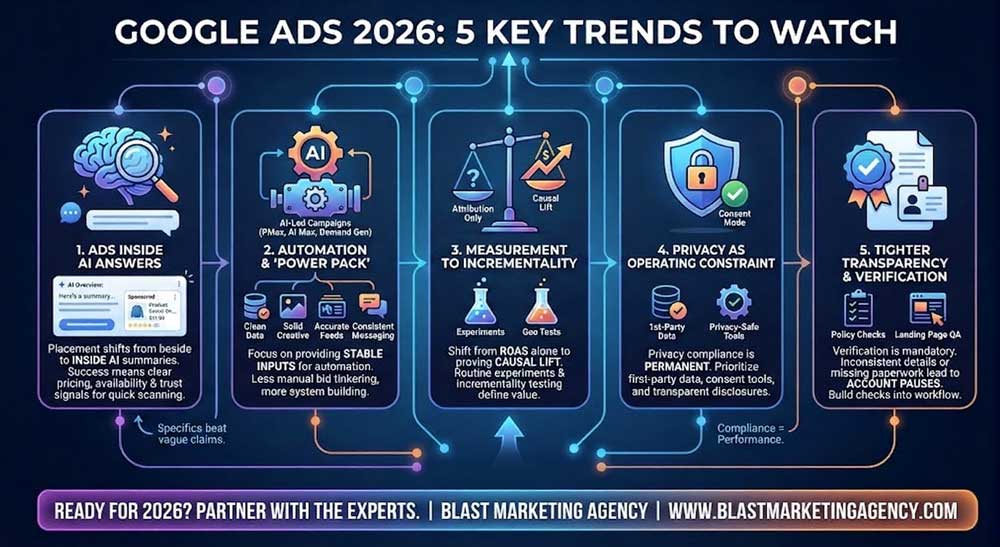
1) Ads appear inside AI answers, not just beside them
- Google has started showing ads in AI Overviews and has confirmed an expansion beyond the U.S. to additional English-speaking markets by the end of 2025.
- That sets up 2026 as the first full year when many brands compete inside AI-generated answer spaces, not only on the traditional results page.
- This placement changes what “good copy” looks like. Users scanning an AI overview often want a shortlist: clear pricing, availability, and a reason to trust the click.
- Vague claims blend into the surrounding summary. Expect more value in specific language, strong merchant data, and landing pages that answer the query fast.
2) Google’s “Power Pack” pushes automation into the center
- At Google Marketing Live 2025, Google highlighted a bundle of AI-led campaign approaches across Search and YouTube, centered on Performance Max, AI Max for Search campaigns, and Demand Gen.
- AI Max is designed to expand into new queries using broad match and keywordless technology while keeping advertiser controls and reporting.
- In 2026, many accounts will run fewer campaign types with wider reach, then spend more effort shaping the inputs: clean conversion tracking, solid creative, accurate feeds, and consistent messaging.
- Reliable Google ads management becomes less about constant bid tinkering and more about building a stable system that automation can learn from.
3) Measurement shifts toward incrementality and experiments
- As automation grows, attribution alone feels less convincing. Google has been expanding access to incrementality testing and positioning it as a practical way to measure causal lift.
- For 2026, expect more brands to treat experiments as routine, not special projects. That means geo tests, holdouts, and clearer definitions of “new customer” value.
A sharp Google ads specialist will still watch ROAS and CPA, but they’ll also ask: did ads create extra sales, or just claim credit for sales that were already coming?
4) Privacy becomes a steady operating constraint
- Cookie timelines have zig-zagged, and reporting indicates Google stepped back from fully removing third-party cookies in Chrome, keeping existing controls while continuing other privacy work.
- Even with that uncertainty, consent requirements remain firm in key markets. Google spells out consent and CMP requirements for serving personalized ads in regions such as the EEA and the UK.
- So, the 2026 playbook is straightforward: prioritize first-party data collection that users understand, implement Consent Mode where needed, and use privacy-safe conversion tools like Enhanced Conversions when it fits your setup. Treat compliance as part of performance, not a separate checklist.
5) Transparency, verification, and enforcement keep tightening
- Google continues to require advertiser verification for many accounts, and verified information can appear in ad disclosures and the Ads Transparency Center.
- In 2026, this trend raises the cost of sloppy operations. Missing paperwork, inconsistent business details, or thin landing pages can lead to pauses that interrupt revenue at the worst time.
- Smart teams build verification, policy checks, and landing page QA into their regular workflow.
A practical way to respond is to pick one improvement in each area: refresh your creative library, tighten conversion tracking, document consent and verification steps, and schedule a quarterly experiment. None of that is flashy, yet it’s the kind of work that keeps automated campaigns stable when Google ships another change.
Frequently Asked Questions
1) What are the biggest trends predicted for 2025?
Google pushed AI-led campaign types in 2025, spotlighting Performance Max, AI Max for Search, and Demand Gen. Ads also moved into AI Overviews, creating new competition for attention inside search answers.
2) What are the key marketing trends in 2025?
More automation, more video, and tougher measurement standards defined 2025. Privacy work stayed central too, with consent tooling and first-party data plans becoming routine for many brands.
3) Will keywords still matter in Google Ads in 2026?
Yes. Keywords still signal intent, but broad match, keywordless expansion, and audience signals keep growing. Think in themes, then use negatives and brand controls to protect relevance.
4) How should small businesses prepare for AI Overviews ads?
Lead with a clear offer and a fast landing page. Test a few distinct ad angles, watch search terms and placement insights, and trim what doesn’t convert. Keep product data accurate. Set aside a small budget for ongoing tests each month.
5) Is privacy getting easier or harder for advertisers?
Stricter, but steadier. Cookie plans may soften, yet consent and transparency expectations remain. Plan for compliant tracking, clear disclosures, and basic data governance that supports reporting.