
Paid media has reached a point where “more clicks” is no longer a valid or logical business goal by itself. In 2026, companies that outpace competitors are the ones that connect spend to outcomes: qualified leads, booked appointments, pipeline, and profitable sales. That mindset matters whether you manage campaigns in-house or you’re evaluating PPC services in NJ and want proof that ad dollars translate into real demand, not just traffic.
The 8 changes to keep your paid media competitive
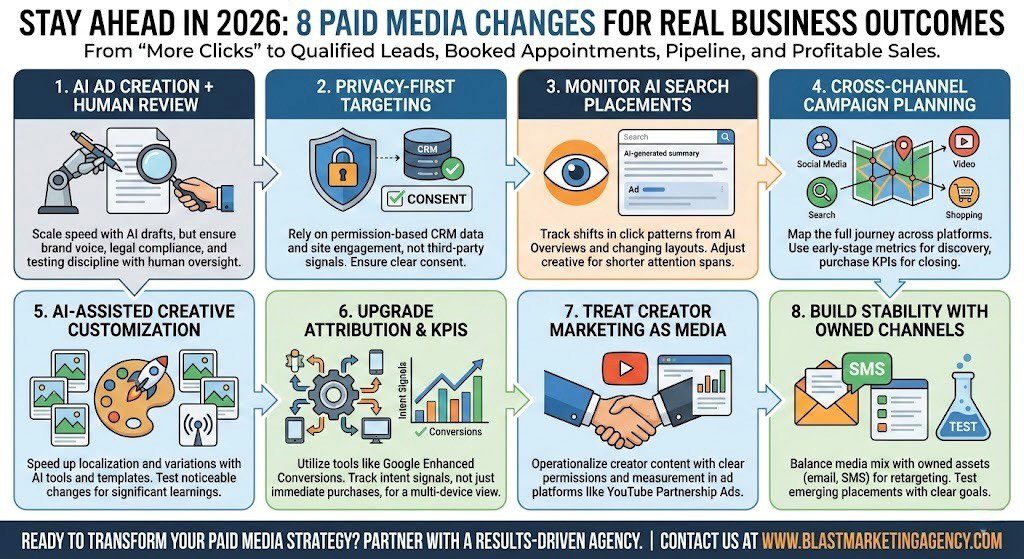
1) Use conversational AI to scale ad creation but keep human review in the loop.
The practical win is speed: faster copy variations, fresh angles, and quicker iteration cycles. The risk is lack of credibility and your unique voice. If every advertiser leans on the same prompts, ads start to blur together. Set a schedule for review and treat AI outputs as drafts that still need brand voice, legal checks, and testing discipline.
2) Update your targeting for privacy changes
Online tracking isn’t as easy as it used to be. A lot of the data advertisers relied on (like third-party cookies) doesn’t work as well anymore. So, instead of trying to “track everything,” build targeting around data you actually own and have permission to use.
Use audiences like:
- Your customer list / CRM list
- People who visited your website
- People who filled out a form, called, or booked before
- Groups based on your own records (location, service type, past buyers, etc.)
Also make sure you’re using this data the right way: clear consent, clear privacy notices, and clean lists.
3) Watch AI-driven search placements:
AI-generated summaries and changing search layouts can shift click patterns in ways that surprise even experienced teams. Treat this like any other placement change: segment performance where you can, compare engagement, and adjust creative to match shorter attention spans. Industry reporting has noted Google’s expansion of ads within AI Overviews to more markets, which raises the stakes for monitoring how your search campaigns show up.
4) Plan campaigns across channels instead of treating each platform as a silo.
Consumers move between social, search, video, and shopping surfaces without thinking about your org chart. Map the journey you actually see in analytics and CRM: discovery, consideration, return visits, then conversion. Use platform-specific metrics for early-stage channels, and reserve purchase-focused KPIs for campaigns that are built to close.
5) Customize creative faster with AI-assisted image editing and templates.
Speed is a competitive advantage, especially when you’re running multiple audiences, locations, or offers. Templates help you maintain brand consistency while still giving you room to localize visuals and messages. When you test creative, test changes that are noticeable enough to matter. Tiny tweaks often produce tiny learnings.
6) Upgrade attribution and adjust KPIs to match how people buy.
A multi-device world makes direct tracking harder. At the same time, businesses still need accountability. Google’s Enhanced Conversions is one option that aims to improve conversion measurement by using hashed first-party data, which can reduce gaps between clicks and reported outcomes. The point is not “track perfectly.” It’s to track consistently enough that decisions hold up over time.
Also, avoid forcing every channel into the same KPI box. A top-of-funnel video campaign should not live or die on immediate purchases. Look at signals that match intent: engaged-view behavior, branded search lift, returning visitors, and assisted conversions.
7) Treat creator marketing like a real media channel, not a side project.
Creator content can perform well because it feels native to the platform. The shift in 2026 is operational: brands can run partnership-style placements with clearer permissions and measurement. For example, Google describes partnership ads as a way for brands to use YouTube creator videos in campaigns and access performance-related features within the ad platform workflow.
8) Build stability with channels you own and a few emerging bets.
Platforms change fast, and budgets can get trapped where performance used to be strong. Balance your mix with assets you control: email, SMS, and customer lists that support retargeting and retention. Then pick a small number of emerging placements to test with clear goals, not curiosity. The best tests produce a decision: scale, pause, or refine.
For a local business, these updates often surface in simple questions: Are calls qualified? Do leads show up? Does paid media increase branded search and repeat visits? A disciplined PPC agency in NJ & NYC should be able to answer those without hiding behind CTR charts.
Frequently Asked Questions:
1) What KPIs matter most for paid media in 2026?
Outcome KPIs lead the list: qualified leads, booked appointments, revenue, and profit where you can calculate it. Pair those with efficiency metrics like cost per qualified lead or cost per booked call. Keep a smaller set of diagnostic metrics (CTR, CPC, landing-page conversion rate) to explain changes week to week.
2) Should I still care about clicks and CTR?
Yes, but as indicators, not as goals. Clicks can help you spot creative fatigue, weak targeting, or poor query matching. A rising CTR is only “good” if downstream outcomes stay healthy. If CTR improves while lead quality drops, the click metric is telling you the story is moving in the wrong direction.
3) How can I measure conversions when tracking is limited?
Start with clean tagging and consistent conversion definitions. Then use first-party measurement options where appropriate. Google’s Enhanced Conversions, for example, is designed to improve conversion measurement using hashed first-party data. If sales happen offline, connect CRM stages back to campaigns so lead quality shows up in reporting.
4) Are AI Overviews changing paid search results?
They can. When search layouts change, user behavior changes with them. Industry coverage has reported Google expanding ads within AI Overviews to more markets, which means advertisers may see new placements and different engagement patterns. The practical move is to monitor performance shifts and update creative for quick comprehension.