

When the December 2025 core update finished rolling out, many sites saw rankings and clicks swing. Google’s status page lists the rollout as December 11 to December 29, 2025. Just in case you didn’t know, core updates in SEO are broad changes to ranking systems, so the usual story is a reshuffle in what Google thinks best matches a query, not a manual action.
1) Pause the panic edits and mark the dates
Annotate the rollout window in analytics and rank tools. Google recommends waiting at least a full week after a core update completes before you analyze in Search Console, so you don’t plan around noisy data.
2) Check the Google Search Status Dashboard
If a rollout is still in progress or a ranking incident is active, your trend line may still be shifting. For December 2025, Google posted that the rollout was complete as of December 29.
3) Sort losses by page type
Bucket URLs into blog posts, category pages, product pages, service pages, and location pages. A single bucket dropping hints at a template or content-pattern issue. Broad drops point more to site-wide quality signals.
4) Run one clean Search Console comparison
After the waiting period, run a Google Search Console performance comparison: compare a week after completion to a week before the update began, as Google suggests. Flag patterns like “position down across many queries” versus “CTR down with steady impressions,” which often signals a snippet or intent mismatch.
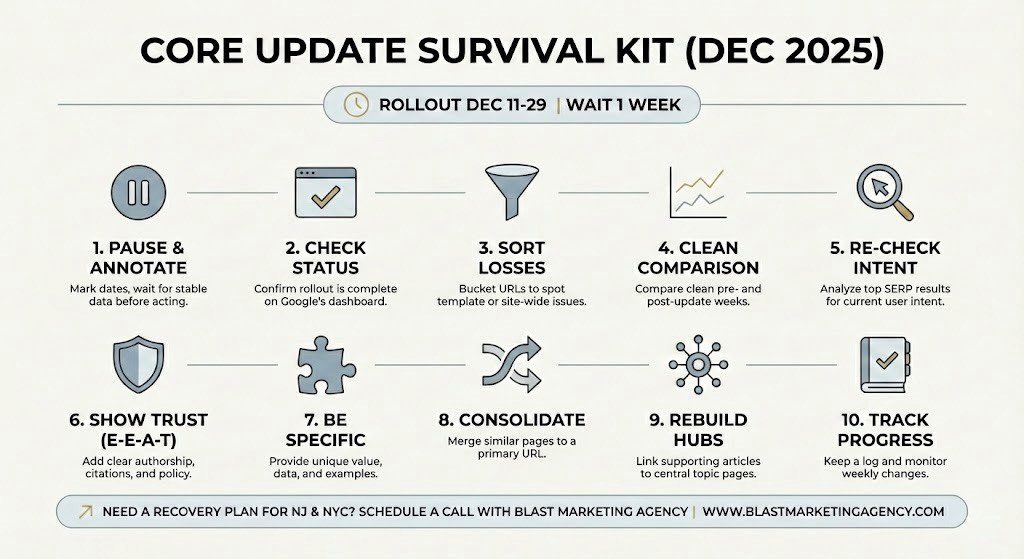
5) Re-check intent using the live SERP
Search your top losing queries and study what Google is rewarding now. If the winners are lists and your page is a long guide, or the winners are product grids and you lead with theory, reshape the page so it answers the current intent quickly.
6) Make trust visible on the page
Add clear authorship, a short author bio link, and an editorial policy page if you publish advice. Use citations for claims that can be verified, and update dates only when you make real edits.
7) Replace “same as everyone else” content with specifics
Take your worst-hit pages and add material competitors lack: screenshots, checklists, first-hand examples, side-by-side comparisons, or tested recommendations with stated trade-offs.
8) Consolidate overlap
If multiple pages target the same intent, merge them into one primary URL and redirect or canonicalize the rest. Then update internal links so your site consistently points to the primary page.
9) Rebuild internal linking around hubs
Create a hub page for each major topic and link to supporting articles. From each supporting article, link back to the hub and to the next logical resource. This helps readers and clarifies which pages you consider core, which will also benefit your SEO strategy.
10) Track progress weekly and keep a change log
Recovery is rarely immediate. Many sites improve as Google recrawls and reevaluates changes over time, and larger shifts can align with later core updates. Keep a dated log of what you changed and watch impressions and clicks weekly.
Schedule a call with Blast Marketing Agency to review what changed after the update and get a clear, prioritized SEO recovery plan for your NJ & NYC businesses.
Frequently Asked Questions:
1. Why did my rankings drop after the December 2025 core update?
Core updates adjust how Google ranks content across the web, so results can move even if you changed nothing. A drop often means other pages now look more relevant or more satisfying for the query. Start by identifying which page types and intents lost visibility, then compare your pages to the current winners.
2. How do I confirm the December 2025 core update is the cause of my traffic loss?
Line up the decline with the rollout window (December 11–29, 2025). Then wait a week after completion and compare a week after vs. a week before the update began in Search Console. Also rule out tracking changes, downtime, and seasonality before you blame the update.
3. How long does it take to recover from a Google core update?
There’s no fixed timeline. Some sites move in weeks once Google recrawls improved pages, while others see bigger changes during later core updates. Look for a steady rise in impressions for key queries over several weeks, not a single-day jump.
4. Should I delete thin content after a core update or improve it?
Do both, selectively. Merge or remove pages that are outdated, duplicative, or off-topic. Improve pages that serve a real need by adding clearer steps, better examples, and verifiable sourcing. Avoid mass deletions made in frustration, since you can remove pages that still earn links and brand searches.
5. Can internal linking fix ranking drops after a core update?
Internal links help by showing which pages are central and by guiding readers to related answers. They won’t rescue a page that misses intent or feels untrustworthy. Use internal linking to concentrate attention on your best pages, then strengthen those pages so they earn the ranking.