People rarely discover something in one place and decide in that same place. They spot a tip in a short video, skim comments for reassurance, then turn to Google for details. That blended behavior is the everyday reality of social search. For brands, the gap between those moments is where attention often leaks.
Here are six practical moves to align SEO and social so the work compounds instead of resetting every week.
1) Build one “question backlog” for both teams
Separate content calendars create duplicates and blind spots. A shared backlog should include:
- Questions people ask before buying
- Questions they ask after buying (setup, fixes, returns)
- Comparisons they make when they feel stuck
2) Let social test topics, then let SEO keep the receipts
When a post draws saves, shares, or detailed comments, you have proof of interest and the exact wording people use. Turn that into a page that can rank and convert:
- A plain-language explainer
- A step-by-step guide
- A “vs.” comparison that names tradeoffs
Research on TikTok shows users do treat social platforms as places to search for information, even if traditional search still wins on some functional needs.
3) Run social listening for SEO like a weekly habit
You do not need fancy tooling. Spend 30 minutes:
- Reading comments on your best posts and your competitors’ best posts
- Noting repeated objections and “is it worth it?” phrasing
- Checking if the same wording appears in site search or support tickets
Use what you find to adjust headings, FAQs, and internal links, so the page answers what people actually mean.
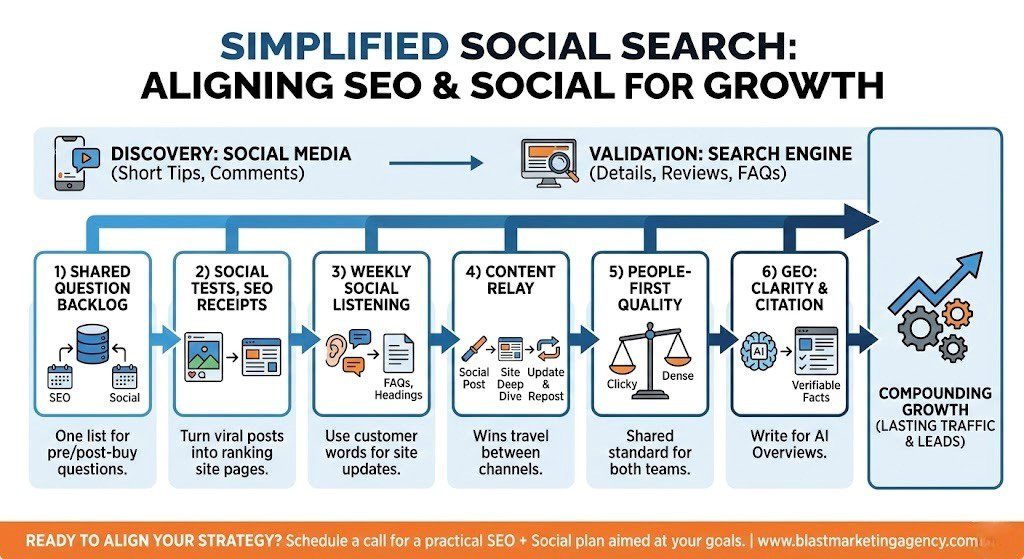
4) Set up a content relay so wins travel between channels
A relay keeps social from feeling like a treadmill:
- Publish a social post that answers one narrow question.
- If it lands, publish the deeper answer on your site.
- Update the original post with a follow-up and link.
- Repost later, pointing to the evergreen page as the reference.
5) Make “people-first” the shared quality standard
When the two channels clash, quality is usually the issue: clicky captions versus careful pages, or dense pages nobody shares.
Google also notes that it evaluates quality regardless of how content is produced.
6) Generative Engine Optimization (GEO): Write for Clarity and Citation
Google describes AI Overviews as quick snapshots with links so people can dig deeper. Pages that tend to earn citations are clear and specific:
- Answer the question early, then add context
- Use question-style headings
- Keep facts easy to verify (steps, definitions, dates)
Ready to turn your social posts into lasting search traffic (and more leads)? Schedule a call with Blast Marketing Agency for a practical SEO + social plan built around your goals.
Frequently Asked Questions:
1. Does social media affect SEO rankings in NJ & NYC?
Social activity does not automatically move rankings. The link is indirect. Strong distribution can increase branded searches, attract visitors who later link to you, and spark discussion on platforms that appear in search. Treat social as demand creation and SEO as the place that captures and converts demand.
2. How do I align SEO and social media into one strategy?
To align SEO with social media marketing, start with a single list of audience questions, then decide what each channel does first. Social can test hooks and language quickly. SEO can publish the complete answer on a stable page that stays useful. Set one shared goal, like “increase sign-ups from informational pages,” so teams stop optimizing in isolation.
3. How do I use social listening to find SEO keywords?
Look for repeated phrasing in comments, creator reviews, and community threads, then confirm intent with your own data. Check Search Console queries, your site search bar, and support tickets for the same wording. Use those terms in headings only when you can answer them.
4. What KPIs prove search + social synergy is working?
Watch leading and lagging indicators together. Leading indicators include saves, shares, and link clicks from social. Lagging indicators include branded searches, returning visitors, and conversions from the evergreen pages you linked. The clearest sign is a rising baseline: after a campaign ends, key pages keep earning visits and leads.
5. How do I get my brand cited in ChatGPT / Perplexity answers?
AI systems tend to quote sources that parse well and earn trust. Publish pages that define terms cleanly, cite primary references for factual claims, and keep stable URLs for your best explanations. Clear headings and short, self-contained sections help.