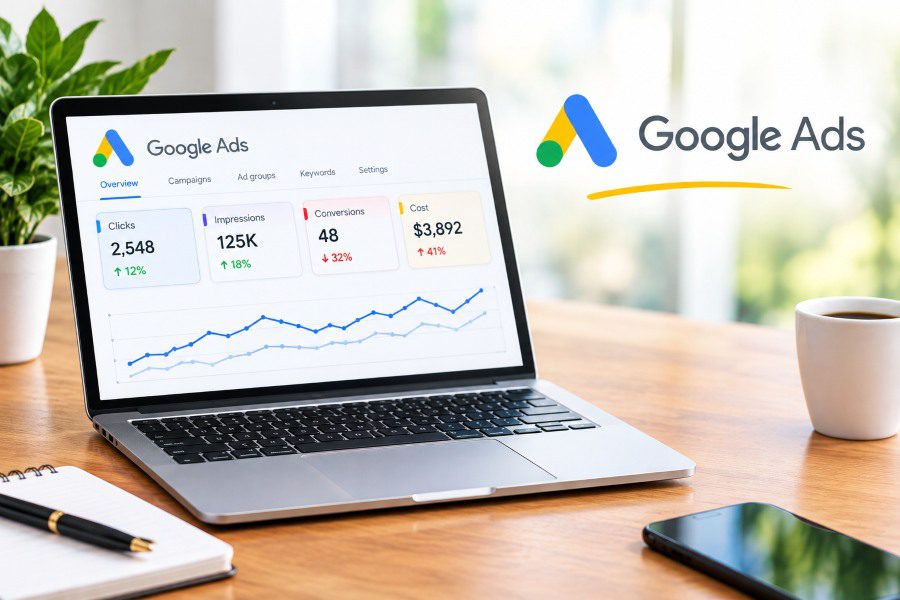
Your Google Ads budget is bleeding money when clicks are coming in, but qualified leads, calls, bookings, or sales are not. The most common causes are weak conversion tracking, broad targeting, irrelevant search terms, poor landing pages, ignored mobile performance, and campaign decisions based on clicks instead of revenue.
A profitable campaign should tell you where every dollar goes. Proper Google Ads management will focus on tracking, keyword conversions, ROAS, transparency, and reducing wasted spend.
1. You are tracking clicks, not real conversions
Clicks are not customers. If your account only reports traffic, you cannot tell whether ads are producing calls, form fills, quote requests, bookings, or purchases. Google explains that advertisers can track actions such as purchases, sign-ups, quote requests, phone calls, and button clicks.
Fix this first. Define primary conversions that create revenue, then separate them from soft engagement actions.
2. Phone calls are not being measured
For local service businesses, restaurants, venues, medical offices, and professional services, phone calls may be the highest-value action. If call tracking is missing, your reports are incomplete. Google Ads provides phone call conversion tracking so advertisers can see how ads lead to calls.
3. Your search terms report is full of irrelevant queries
Keywords are what you bid on. Search terms are what people actually typed. The Google Ads search terms report shows which searches triggered your ads and how they performed. If the report includes jobs, free options, DIY searches, unrelated cities, or low-intent research terms, your budget is leaking.
4. You are not using negative keywords
Negative keywords help exclude irrelevant searches and focus spend on people who matter. Google explains that negative keywords can improve targeting and help increase ROI. If you never review and expand your negative keyword list, you are paying Google to educate the wrong audience.
5. Your campaigns are too broad
Broad match can expand reach, but it needs structure, strong conversion data, and active review. If every service, location, and audience is blended into one campaign, Google has weak signals. Segment campaigns by service line, location, intent, and value.
This is especially important in competitive markets. A Manhattan digital marketing agency must account for high ad costs, neighborhood-level targeting, and buyer intent because every click is expensive.
6. Your landing page does not match the ad
Google says ad quality is based on expected clickthrough rate, ad relevance, and landing page experience. If your ad promotes emergency service, private dining, wedding venue tours, or legal consultations, the page should speak directly to that need.
Do not send every click to your homepage. Send each campaign to the most relevant page.
7. Your mobile experience is costing you leads
If forms are hard to complete, buttons are tiny, pages load slowly, or phone numbers are not clickable, mobile users leave. Focus on building websites that support action, not just appearance. For Google Ads, the landing page is part of the campaign.
8. You cannot tell which leads are qualified
A lead is not automatically a good lead. A venue inquiry for a 20-person party is different from a corporate gala. A low-budget inquiry is different from a ready-to-buy prospect. Your event venue marketing approach should emphasize on high-quality leads, bookings, and revenue; not just impressions or clicks.
9. Your campaigns ignore location intent
Local ads waste money when they target too widely or fail to separate profitable service areas. Google Business Profile visibility also matters because people compare ads, maps, reviews, and websites together.
10. You accept every Google recommendation blindly
Google’s optimization score estimates how well an account is set to perform, but recommendations still need human judgment. Some suggestions may increase reach without improving profit. Review recommendations through the lens of cost per acquisition, lead quality, and revenue.
11. You have no case-study benchmark
Performance should improve after restructuring. In Blast Marketing’s large NYC event venue Google Ads case study, a fragmented account was rebuilt around service-first intent, conversion hierarchy, and local targeting. The result was an 80.45% increase in total conversions and a 38.18% reduction in average cost per conversion.
12. Your agency reports activity, not outcomes
Reports should explain what changed, what improved, what wasted spend was removed, and what the next test is. If your agency only sends screenshots of clicks and impressions, you are not getting strategic management. A strong partner connects Google Ads with SEO, website performance, content, local visibility, and reputation.
How to stop the bleeding
- Start with an audit.
- Review tracking, search terms, negative keywords, location settings, landing pages, mobile experience, call quality, and conversion value.
- Then rebuild campaigns around high-intent keywords, clear offers, and measurable outcomes.
For businesses that need leads, calls, bookings, or sales, Blast Marketing Agency builds Google Ads systems designed to reduce waste and improve revenue visibility. You can also read more marketing insights on the Blast Marketing Agency blog.
Frequently Asked Questions
How do I know if my Google Ads are wasting money?
Your Google Ads may be wasting money if you are spending consistently but not seeing qualified calls, form fills, booked appointments, quote requests, or sales. The clearest warning sign is a gap between campaign activity and business results. If the account shows clicks and impressions but cannot prove which keywords, ads, or locations are producing revenue opportunities, the budget needs a deeper audit.
What is the fastest way to reduce wasted ad spend?
The fastest way to reduce wasted ad spend is to tighten the connection between search intent, conversion tracking, and landing page relevance. Start by confirming that calls and forms are being tracked correctly, then review the search terms report to find irrelevant queries. From there, remove poor-performing keywords, add negative keywords, and make sure each ad sends visitors to a page that matches what they searched for.
Should small businesses run Google Ads?
Small businesses can absolutely run Google Ads, but the campaigns need to be built around measurable leads rather than general traffic. A small budget leaves less room for guesswork, so targeting, keyword selection, local intent, and conversion tracking matter more. For many businesses, working with a focused Google Ads agency helps prevent spend from drifting into clicks that never become customers.
Why am I getting clicks but no leads?
The keyword may be too broad, the ad may be attracting the wrong audience, or the landing page may not give visitors enough confidence to act. For example, an event venue campaign should not send every visitor to a generic page. It should guide visitors toward availability, pricing, packages etc, which is the kind of strategy used in effective event venue marketing.
How often should I review my Google Ads account?
A Google Ads account should be reviewed regularly enough to catch wasted spend before it becomes a pattern. Search terms, conversion quality, location performance, device performance, and budget pacing should all be checked on an ongoing basis.
Author bio
Robert Kadar is Co-Founder of Blast Marketing Agency, a full-service digital marketing agency serving businesses across New York City, Manhattan, New Jersey, and surrounding markets. As both a marketer and small business owner, Robert brings rich experience helping local businesses grow through SEO, Google Ads, web design, reputation management, listings, content, and social media marketing.